Opening statement
On the evidence of his documented appearances, Sir Nathaniel is the first of the two Dunlop men to investigate. His nephew Binnie supplies a second line through his medical qualification. The birth entry names neither man. The Case for Sir Nathaniel Dunlop reviews each dated sighting and the competing interpretations.
Part 1. The family that owned the place where Agnes lived
- Sir Nathaniel Dunlop owned Shieldhill, a large country house in Lanarkshire, from 1898. He was knighted in July 1907, one month after Laurence was born.
- 1861 census, 50 Abbotsford Place, Glasgow: Archibald Dunlop's household includes sons Nathaniel, 31, and James, 27, physician and surgeon. James was the knight's brother.
- Binnie Dunlop was born 3 August 1874 to Dr James Dunlop and Jane Menzies Binnie. James's obituary (Glasgow Medical Journal, April 1901) names "Dr. Binnie Dunlop" as his son. Binnie was the knight's nephew. That relationship is proven.
- The medical register gave Binnie’s professional address as 16 Carlton Place, Glasgow, through 1907 and Woodford Green from 1908. His former school already listed the Essex address in 1905. These entries cannot date a move or locate him on a particular day.
Part 2. The gardener and his sister
- 1901 census: Alexander Archibald, 30, domestic gardener at Shieldhill, living there with his wife Annie and a servant. He worked for the Dunlops.
- Where the gardener lived (added after review): the 1901 census lists Alexander's household at the address "Shieldhill" itself (Libberton ED 3, schedule 3), not at a lodge or cottage, and the household kept its own live-in servant, Susan Cumisky, 26, which is unusual for a gardener. On census night Sir Nathaniel was in Glasgow, at 1 Montgomerie Crescent, Partick, with his daughter Ellen and seven servants. So in 1901 the gardener's family was the household recorded at Shieldhill while the owner was away, which suggests they may have been living in, or keeping, the house. The census does not say which building they occupied, and no record yet shows the gardener and the knight under the same roof. If they were in the house, the gardener's family would have been the people who knew who came and went at Shieldhill.
- Mary Archibald, born 23 October 1864, Alexander's sister, was at Gean Tree Cottages in 1901.
- Agnes Brown as a neighbor: in 1891 Agnes, age 5, was listed one household from Alexander and Mary. In 1901 she was at Lime Tree Cottage, close to Mary. The census places their households near each other on those two dates. It does not show whether the families knew each other personally.
- The two cottage entries. The 1901 census placed Mary Archibald at Gean Tree Cottages and Agnes at Lime Tree Cottage. Agnes gave Gean Cottage as her own address in 1907. A rental or dated household record is needed to establish whether Mary was still there and whether they lived together.
- Laurence's 1907 birth entry: Agnes, domestic servant, gives her home as Gean Cottage, Shieldhill, and signs as the mother. No father is named.
Part 2b. The hall at the heart of the village (added after review)
Distances, measured from map coordinates: Gean Tree Cottage, the home Agnes gave on the birth entry, is about 400 feet in a straight line from Shieldhill Hall, the corrugated-iron hall Nathaniel and Ellen Dunlop put up in 1903 (listed building LB12995, grid reference NS 99544 39695). Shieldhill House, the Dunlops' own house, is about 0.9 mile from the cottage.
The hall was the centre of village life, and the Dunlops were in it in person. The Hamilton Advertiser reported, on December 30, 1905, a lecture given "through the invitation of Mr and Miss Dunlop" and a Christmas party in Shieldhill Hall, "generously entertained by Mr and Miss Dunlop." On April 6, 1907 it reported that "the lady of the manor," Ellen, had for more than a year run winter evening classes in the hall: a lady governess came from Glasgow two days a week to teach the women of the village, the young people learned music and singing, Ellen played the organ, and "some of the farm servants excel in the reading of the notes." At the closing concert, about March 29, 1907, some 200 people from the village and neighbourhood attended, "the laird of Shieldhill himself took the chair, and his daughter presided at the piano." These were routine, reported events, and the young servants of the estate were part of them, a few hundred yards from Agnes's door, during the months she was pregnant.
The January 4, 1902 Hamilton Advertiser reported a New Year supper and dance inside the mansion for tenants, villagers and estate and house servants. Nathaniel and Ellen were present. The report describes a particular evening. It supplies neither a yearly guest list nor an entry for Agnes.
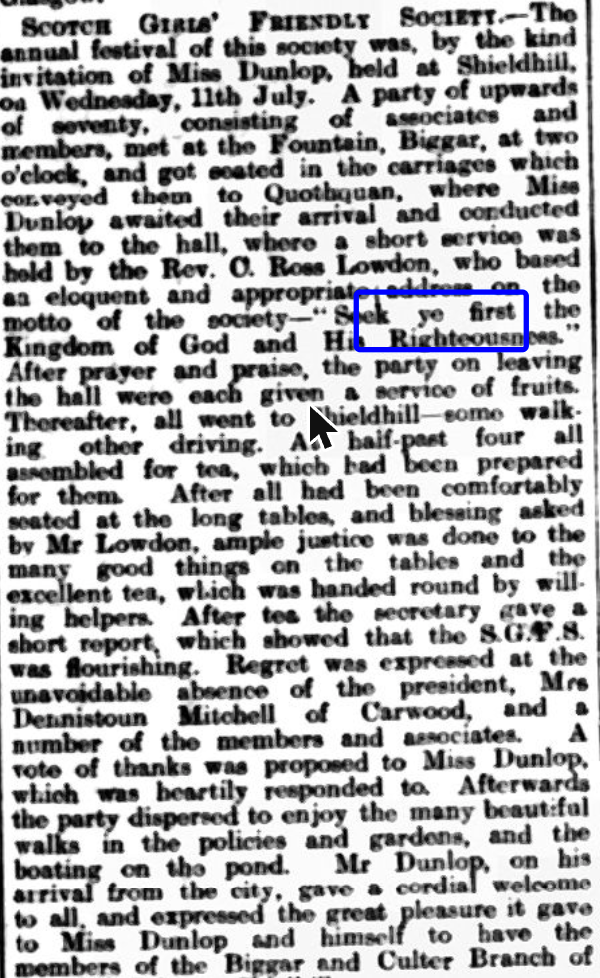
A festival for working girls at Shieldhill, July 1906. On Wednesday, July 11, 1906, about two months before Agnes became pregnant, the Biggar and Culter branch of the Scotch Girls' Friendly Society held its annual festival at Shieldhill "by the kind invitation of Miss Dunlop" (Hamilton Advertiser, July 21, 1906, page 5, British Newspaper Archive; newspaper clipping). The Girls' Friendly Society was a church society for young working women, many of them domestic servants ("members"), overseen by ladies ("associates"). More than seventy came by carriage from Biggar. Ellen met them at Quothquan and took them to the hall for a short service, and then they all went on to the mansion for tea, walks in the gardens, and boating on the pond. "Mr Dunlop, on his arrival from the city, gave a cordial welcome to all." The report gives no list of names, so it does not show whether Agnes was there. It does show the Dunlops hosting young working women at the house itself, with Nathaniel present, in the summer of 1906.
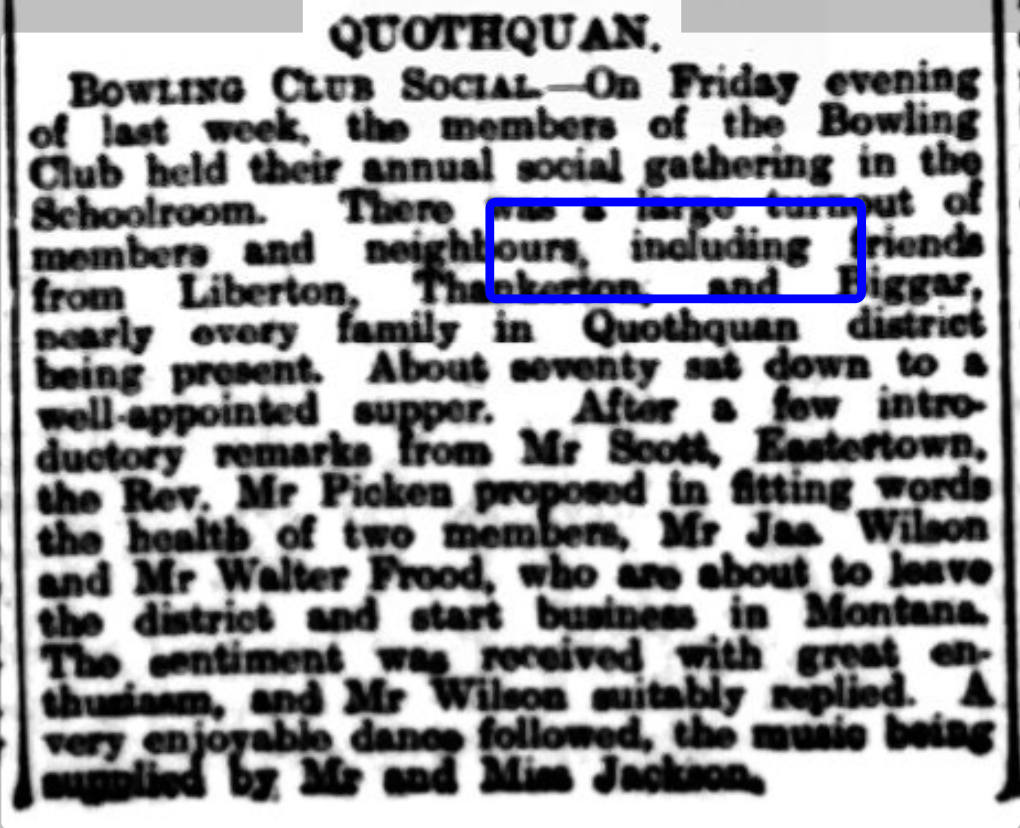
The village social of March 1906. On Friday, March 9, 1906, the Quothquan Bowling Club held its annual social in the village schoolroom (Hamilton Advertiser, March 17, 1906, page 6, British Newspaper Archive). The paper says nearly every family in the Quothquan district was there, with guests from Libberton, Thankerton and Biggar, and about seventy sat down to supper. Mr Scott of Eastertown spoke first, and the Rev. Mr Picken of Shieldhill Hall proposed a toast to two members, Mr James Wilson and Mr Walter Frood, who were leaving to start business in Montana. A dance followed, with the music by Mr and Miss Jackson (newspaper clipping). A Mr Jackson was also one of the singers at the 1902 New Year dance in the mansion. The report names no Dunlop, and no one named in it is Agnes. It shows how often the whole village, servants included, gathered together in the year Agnes became pregnant.
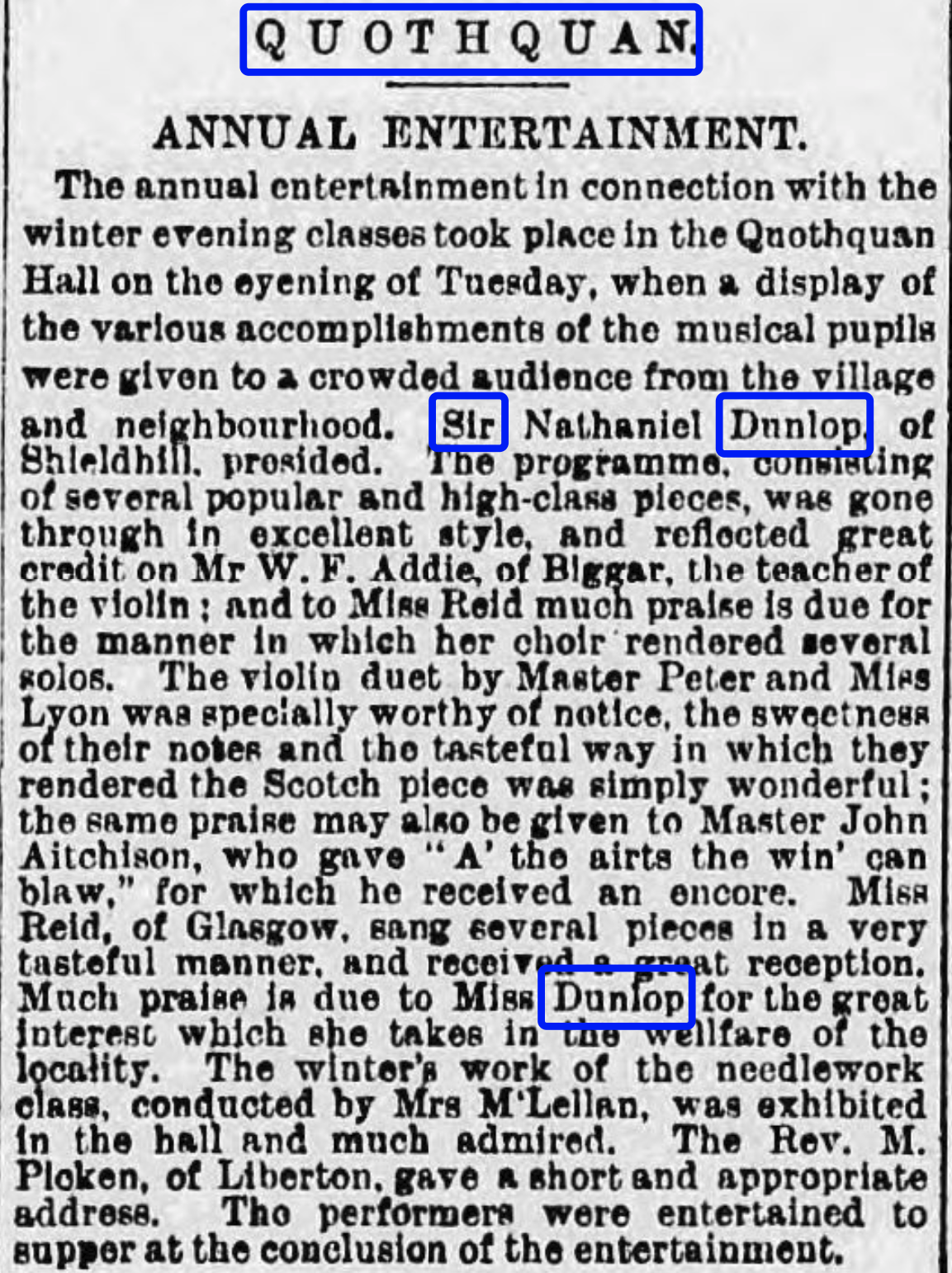
The classes were still running in 1910, with a singer from Glasgow. On Tuesday, March 29, 1910, the annual entertainment for the winter evening classes was held in the Quothquan Hall before a crowded audience from the village and neighbourhood, with Sir Nathaniel Dunlop of Shieldhill presiding (Hamilton Advertiser, April 2, 1910, page 6, British Newspaper Archive; newspaper clipping). Mr W. F. Addie of Biggar taught violin. Miss Reid led a choir, and "Miss Reid, of Glasgow" sang several pieces. Miss Dunlop was praised for the great interest she took in the welfare of the locality. Mrs M'Lellan ran the needlework class, the Rev. M. Picken gave an address, and the performers were given supper afterwards. The 1907 report described a governess coming from Glasgow two days a week to teach the classes. Miss Reid of Glasgow may be that teacher, which still needs checking.
The records connect Agnes to a cottage address and a birth in Edinburgh. The questions are who, if anyone, helped her during the pregnancy and how Laurence came into the Douglas household. Neither the gardener nor an estate payment has been established in that chain.
Part 3. The choice of hospital
Most women gave birth at home. National Records of Scotland estimates that about 95% of all births in this period, among rich and poor alike, were home births (National Records of Scotland, "Safe delivery: a history of Scottish midwives"). Agnes had a home: on the birth entry she gave her domicile as Gean Cottage, Shieldhill, the estate owned by the knight, Binnie Dunlop's uncle. She could have given birth there with a local midwife, as most women did. Instead she went about 25 miles to a hospital in another city. That makes the hospital birth itself unusual, before even asking why it was Edinburgh.
Agnes’s recorded destination was Edinburgh. Home delivery, medical advice and personal contacts are among the possibilities to consider. No letter, referral or diary records which choices Agnes considered.
The journey itself (added after review). How and when Agnes reached Edinburgh is not recorded. If she went by train from the Biggar area, it was a trip of roughly 25 miles, probably with a change of trains. Unmarried women were often admitted to the Edinburgh hospital before labour, so she may have gone days or weeks ahead. From the Biggar area the line most likely ran on the Caledonian Railway into Edinburgh's Princes Street station, about two-thirds of a mile from the hospital, partly uphill by Lothian Road and Lauriston. Her train time and travel date are not recorded, so the weather on her journey cannot be known. The hospital casebook for June 1907 should give her admission date, which would show how far ahead the trip was arranged. Three years and ten months later, the baby is living about half a mile from that hospital.
Laurence was born on June 14, 1907, at the Royal Maternity Hospital in Edinburgh. The next civil entry records another unmarried domestic servant who gave birth there. Agnes’s own admission and discharge entries may help explain her circumstances. Her choice of city identifies neither a financier nor a father.
Part 4. Where the baby went
- 1911 census, 16 Lochrin Place, Edinburgh: Elizabeth (Lizzie) Douglas, her daughter Janet, and three-year-old "Laurence B.," recorded as son. Lochrin Place is about 0.2 miles from the maternity hospital.
- The gap (added after review): Laurence's whereabouts between his birth in Edinburgh on 14 June 1907 and the census of 2 April 1911 are unknown. No record shows him going back to Shieldhill. What is known is that Agnes was still in Edinburgh on 4 July 1907, twenty days after the birth, when she registered him at St Giles. The weather (Leith observations, found by ChatGPT): on 14 June 1907, the day of the birth at 9 p.m., it was 52°F with three-quarters cloud at 8 a.m. and 59°F and overcast at 6 p.m. On 4 July, the day she registered him, it was 50°F and overcast at 8 a.m. and 49°F with rain at 6 p.m. The registration hour is not recorded. The St Giles registrar was at 24 Forrest Road in the 1907 directories (found by ChatGPT): about 0.41 miles in a straight line from the hospital, and about 0.58 miles from 18 Lochrin Place, both an easy walk. She gave Gean Cottage as her home, but that is the address she claimed, not proof she went back there, or that the baby did.
- No legal adoption existed (added after review): legal adoption did not exist in Scotland until the Adoption of Children (Scotland) Act 1930. Before that, a child could only be placed with another family by private arrangement. No document about Laurence's placement has been found, and his birth entry was never changed. Agnes registered him on 4 July 1907 under her own surname, as Lawrence Brown. In 1911 he was listed as Lizzie's son, and in 1912 his school register described him as adopted. When he emigrated in 1929 he travelled as Lawrence Brown. Why he used that name in 1929, and how he came into the Douglas household, are not recorded. The "B." in "Laurence B. Douglas" may stand for Brown, but that is not documented.
- Lizzie's own history: born 31 May 1874 at Gilmerton to Ann McDonald, domestic servant. The entry is marked illegitimate and names no father. She was raised by her grandparents and put their names in the parents' column when she married Robert Douglas in 1899. She had lived the same path Laurence did.
- The neighborhood: every address for Lizzie is within a mile of the hospital: 4 Hatton Place (1899), 5 Beaumont Place (1901), 16 Lochrin Place (1911).
- Agnes stayed near her son: Agnes did not go back to the estate for good. By 1911 she was a nurse at the Royal Edinburgh Asylum in Morningside. She married Thomas McKay McKenzie there on 28 August 1911, before the same registrar who had recorded Laurence's birth. In 1912 she was at 9 Stewart Terrace, and in 1915 at 62 Balcarres Street (1912 birth; 1915 army papers). Each of these three places is only about 1.1 to 1.2 miles in a straight line from 16 Lochrin Place, where Laurence was living as Laurence B. Douglas in 1911. Gean Tree Cottage is about 25 miles away. (The Douglases moved to Dunfermline in 1912, so from then on Laurence was farther away.)
Part 5. The witness
Ever since Doug was young, his mother, Laurence's daughter, has said without hesitation that the father was a doctor at the estate, and that a gardener took him in. She said it for decades, long before any of these records were found.
The records identify a gardener and two distinct uses of “doctor”. They leave the identities and actions described by the family account open.
The doctor. There was a doctor in the estate owner's own family: Dr Binnie Dunlop, nephew of Sir Nathaniel Dunlop of Shieldhill.
The gardener. Alexander Archibald’s 1901 household address reads “Shieldhill.” The entry does not specify the building he occupied.
Mary Archibald, the gardener’s sister, lived at Gean Tree Cottages in 1901. Agnes gave Gean Cottage as her own address in 1907. Their proximity is worth investigating. There is no contemporary account of Mary sheltering Agnes or Alexander taking the baby.
The testimony directs the search to people and records. Identifying people who fit a description still leaves their individual roles to be established.
Part 6. The theory of the case
- A July 1906 newspaper places Nathaniel welcoming visitors to Shieldhill. Binnie was the estate owner’s nephew. A dated visit by him in 1906 remains unverified.
- Agnes, a young servant whose life centred on Shieldhill, became pregnant around September 1906.
- Did the Archibald family help Agnes during her pregnancy? The census and the birth registration suggest where to look for an answer.
- Agnes delivered her son in Edinburgh. Her reason for going there is unrecorded.
- The 1911 census places the boy with Lizzie Douglas. When and through whom he reached her household is unknown.
- A possibility to test: in the twenty days between the birth and the registration, Agnes may have stayed with, or visited, the Douglases near the hospital, to see that the baby was going to a safe home, before registering him on 4 July. No record yet shows Agnes there. But the Douglases can now be placed near the hospital at the time: a Robert Douglas, with an occupation matching Lizzie's husband, is listed at 18 Lochrin Place in the Edinburgh electoral rolls for both 1906–07 and 1907–08 (reported by ChatGPT; printed entries being checked). Measured from map coordinates, 18 Lochrin Place is about 0.19 miles (about 330 yards) in a straight line from the hospital door at 79 Lauriston Place, roughly a third of a mile, five to seven minutes, on foot by Lauriston Place and Tollcross. The 1879 hospital building still stands, now a hotel. That is next door to No. 16, where the 1911 census found Laurence, and well under half a mile from the hospital. The hospital's record of where Agnes went on discharge would test the rest.
- Binnie had addresses associated with Glasgow and Essex. Their dates do not establish when he travelled between them.
Part 6b. The case for Sir Nathaniel himself (added November 22, 2026)
Newspaper research since this presentation was first written makes Sir Nathaniel Dunlop, not his nephew, the stronger candidate on the documents.
- He was there. The papers place him at Shieldhill among his servants and villagers: the New Year supper and dance in the mansion house for "tenantry, villagers, estate and house servants" (1902); the Girls' Friendly Society festival for young working women at Shieldhill on July 11, 1906, where "Mr Dunlop, on his arrival from the city, gave a cordial welcome to all," about two months before Agnes became pregnant; and the hall concert he chaired in 1907. No record yet places Binnie at Shieldhill at all.
- The 1906 water-supply report establishes Nathaniel’s ownership of houses at Quothquan. It does not identify the proprietor or tenant of Gean Cottage by name.
- His honorary law degree dates to April 1907, after the estimated conception. Newspapers later styled him “Dr”. Binnie held a medical qualification. The family recollection leaves both interpretations open.
- His positions in shipping and the Clyde Trust attest to his means. No account, receipt or letter identifies a payment on Agnes’s behalf.
Against him: he was about 76 in the autumn of 1906 (he was 31 in the 1861 census). The papers place him in Glasgow on June 21 and July 2, 1907, and nowhere yet in Edinburgh during Agnes's stay there.
Part 7. What the defense would say
- No record puts Binnie at Shieldhill or near Agnes. This is the biggest gap.
- Estate gardeners lived on the estate. That was his job. The census gives the address as Shieldhill, not which building.
- The census places Agnes near the Archibalds in 1891 and 1901. That Mary supervised the pregnancy is a reasonable guess, but no record says it.
- Other men were at Shieldhill: the knight, staff, visitors, men in the village. The records name none of them either way.
- The birth register itself shows Agnes was not unusual at that hospital: the very next entry, six days later, is another unmarried domestic servant who also delivered there. Unmarried servants going to the Edinburgh hospital was a known path.
- Edinburgh has innocent explanations: a large teaching hospital that took unmarried women, distance from Agnes's own community, or a referral by a church, employer or midwife.
- Doctors moved to England for jobs and marriages.
- The family account is secondhand and over a century old. "A doctor" could describe many men.
- The "B" in "Laurence B." most likely stands for Brown, his mother's surname, not Binnie.
- No record yet shows how Agnes's side connected to Lizzie's side.
Part 8. Assessment
Sir Nathaniel is the stronger of the two estate leads because of the contemporary record of his presence. Binnie has the closer occupational fit. Neither man has a documented meeting with Agnes, and Laurence’s father remains unidentified.
Part 9. Records that could settle it
- DNA: an autosomal test from Laurence's daughter, his closest living relative, compared against descendants of the Dunlop and Binnie families.
- Royal Maternity Hospital register, June 1907 (Lothian Health Services Archive): referral, prior address, and who received the baby.
- The hospital Register of Births (LHSA, LHB3/14): it can record where each mother went after the birth. Agnes's line could show where she, and perhaps the baby, went next.
- Barbara Shirra, entry 840: another unmarried domestic servant, who delivered six days after Agnes and registered her daughter on the same day (4 July 1907, consecutive entries 839 and 840). Barbara was Edinburgh-born and in 1901 was a pupil at Dr Guthrie's Original Industrial School for Girls, which trained girls for domestic service and placed them in jobs. The school's registers (National Records of Scotland, GD425) could show where it placed her, and whether that was near Agnes or Lizzie. This is a lead into the servant network, not evidence of one.
- A paternity decree: a sheriff-court action for support may appear as a Register of Corrected Entries note on Laurence's birth entry.
- Poor law records: parish relief files often named the alleged father.
- Kirk session minutes, Libberton and Quothquan: churches often recorded the man's name.
- Shieldhill estate papers and the local press, 1906: guests, family visits, Binnie's movements.
- Binnie's letters to Marie Stopes, 1916–1945, British Library Add MS 58564.
Conclusion: the evidence justifies a full investigation. It does not yet justify a conclusion.