The man at Shieldhill
Nathaniel Dunlop was born at Campbeltown on April 7, 1830. He spent half a century with the Allan Line, the Glasgow shipping company whose steamers carried tens of thousands of Scots to Canada, became senior partner of its firm, James & Alexander Allan, and chairman of the Clyde Navigation Trust. His wife died within weeks of the birth of their only child, Ellen, and he never remarried.
In 1898 he bought Shieldhill, near Biggar, from the Chancellor family, who had held it since 1434, and with it the village of Quothquan below the house and its cottages. When he died at Shieldhill in 1919, his will left his daughter alone £100,000.
His face and his own words
Three likenesses of Nathaniel survive in print from these years: a photograph with a 1903 interview, a studio portrait captioned as chairman of the Allan Line, and the marble bust by Sir George Frampton shown at the Royal Academy in 1914. The bust is now in Kelvingrove Art Gallery and Museum, Glasgow.

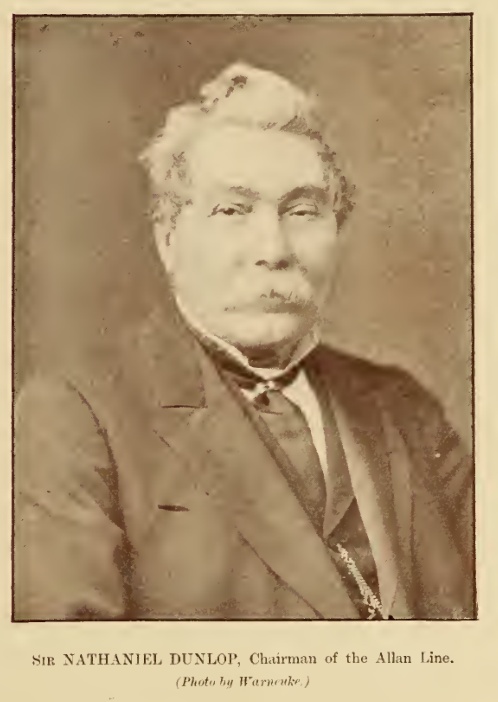

His own words survive too. On May 20, 1909, he wrote from “Shieldhill, Biggar, N.B.” to John Rankin of Liverpool about the old Glasgow merchant houses he had known since he entered business “over 60 years ago.” The full letter is in the Cold Case File. In April 1909 he published “Unemployment: its cause and cure” in Blackwood’s Magazine, calling for duties on imported goods; a free-trade reply in the Westminster Review quotes him at length. His own article is still to be found.
A 1912 biography of Glasgow’s first Medical Officer of Health shows Nathaniel helping to choose that officer in 1863, and names “the late Professor James Dunlop, brother of Sir Nathaniel” among the doctors appointed under him. When he died in 1919, the news reached America: the Chicago Daily Tribune reported that he “was a widower, and is survived by one daughter.”
A home, a hall, and a village
“Domestic servant” is what Agnes Brown wrote when she registered her son. The same record gives her usual home as Gean Cottage, Shieldhill. Those are two different pieces of information. The entry leaves her employer unnamed. It gives us no basis for placing her at work in the mansion, identifying who paid her wages, or saying she attended a particular gathering.
Three places matter. Shieldhill House was the Dunlops’ private residence. A reported supper in its dining room brought tenants and servants there as invited guests. Shieldhill Hall was a separate building in Quothquan. Nathaniel and his daughter Ellen built it in 1903 for evening worship. It later housed winter lessons and a concert. Gean Cottage was the address Agnes gave in 1907. The project’s comparison of modern coordinates puts the cottage about 400 feet from the hall in a straight line. The mansion was farther away.
The same household could invite a villager to worship, provide a room for a class, and receive her socially. Nathaniel also owned houses in the village. A May 1906 water-supply report establishes that much. The account cited here does not name Gean Cottage. A valuation roll or rental naming its proprietor and occupier would answer the narrower question.
Laurence’s civil birth entry · Historic Environment Scotland, LB12995 · Motherwell Times, May 4, 1906 · Estate and newspaper research notes
Who was actually there?
January 1, 1902
Supper and dancing inside Shieldhill House
The Hamilton Advertiser named Mr and Miss Dunlop as hosts. Tenants, villagers, estate servants and house servants came to supper and a dance in the mansion. The paper described supper in the dining room. It is direct evidence that the owners opened their private house across employment and social lines on this occasion. Agnes would have been sixteen. The report gives no evidence that she danced there or that this happened every year.
December 1905
A lecture and Christmas party in the hall
The newspaper attributed the invitation for the lecture to father and daughter and reported a Christmas party in the hall. The named invitation establishes sponsorship. It cannot supply a guest list or put either host at every event.
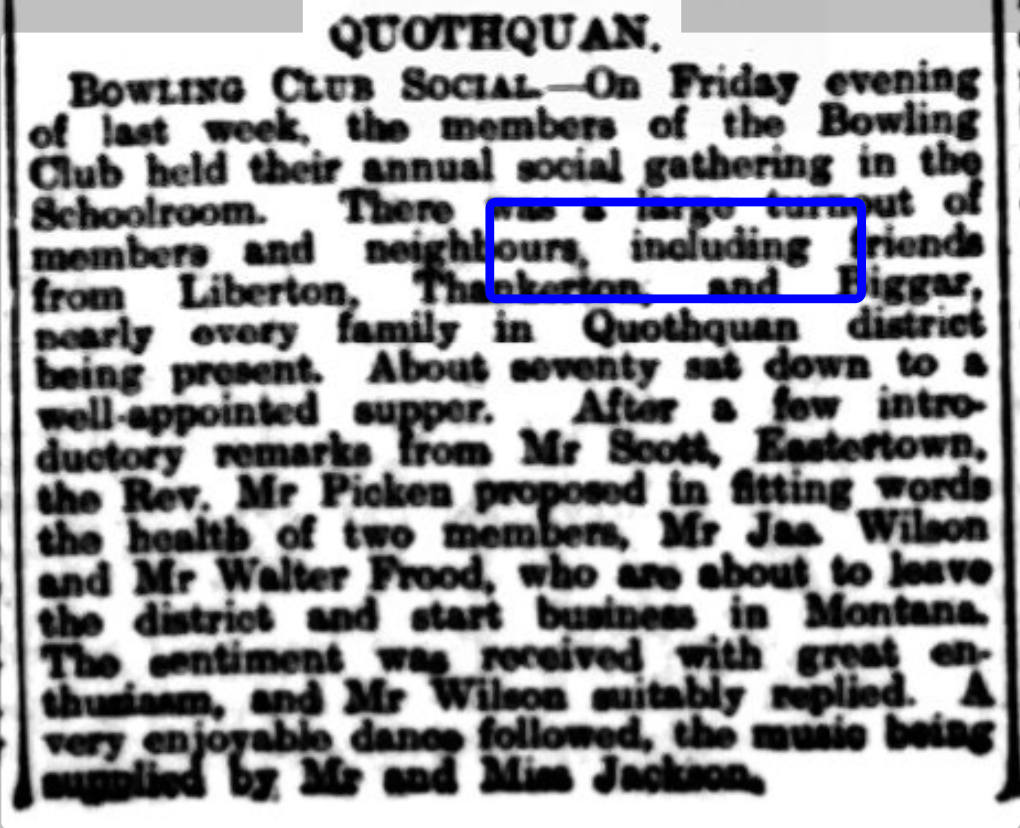
March 9, 1906
A bowling club supper in the village schoolroom
About seventy sat down to supper and a dance followed. The club organized the event. The report names the Rev. Mr Picken and local musicians. It names neither Dunlop nor Agnes. This is an important comparison: Quothquan also had gatherings organized outside the mansion and the Dunlops’ hall.
Hamilton Advertiser, March 17, 1906, page 6 · Issue reference
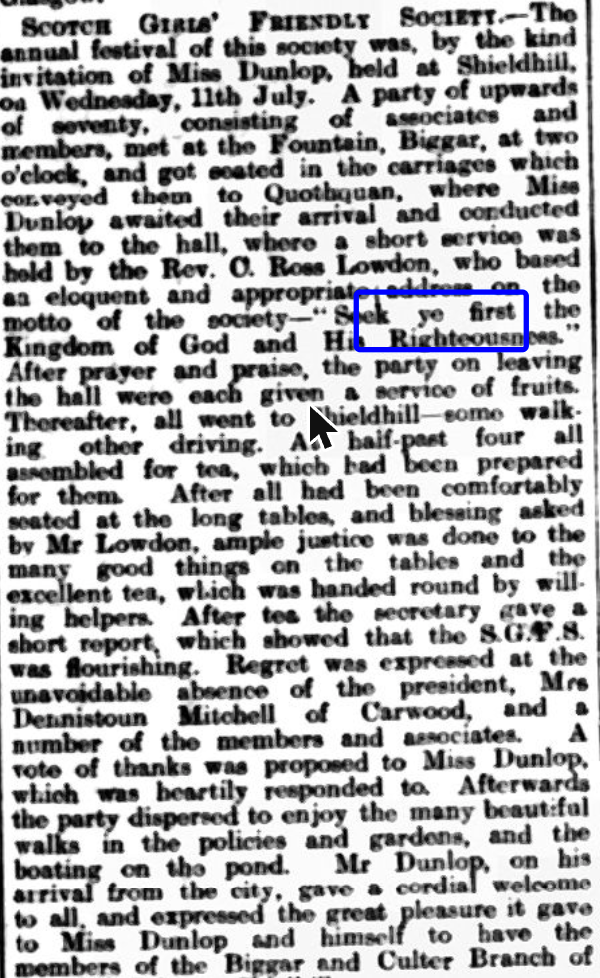
July 11, 1906
From Biggar to the hall, then to Shieldhill
This is the closest dated evidence presented here for Nathaniel at an estate gathering before the estimated autumn conception. More than seventy members and associates of the Biggar and Culter branch of the Scotch Girls’ Friendly Society travelled from Biggar. Ellen met them at Quothquan. The Rev. C. Ross Lowdon conducted the service. The visitors went on to Shieldhill, gathered for tea at half past four and enjoyed the gardens and pond. The paper specifically describes Mr Dunlop arriving from the city and welcoming them. Ellen organized the visit. Nathaniel’s reported arrival places him there for part of it. The clipping lists neither Agnes nor Binnie. It supplies no evidence of a private meeting.
Hamilton Advertiser, July 21, 1906, page 5 · Issue reference
Winter 1906–07
Lessons and the closing concert
The April 6 report describes a teacher coming from Glasgow twice a week, music lessons and farm servants learning to read music. At the closing concert, Nathaniel chaired and Ellen played the piano. About two hundred people attended. The report places the owner publicly at the hall during Agnes’s pregnancy. It cannot identify where he was on a particular day the preceding autumn.
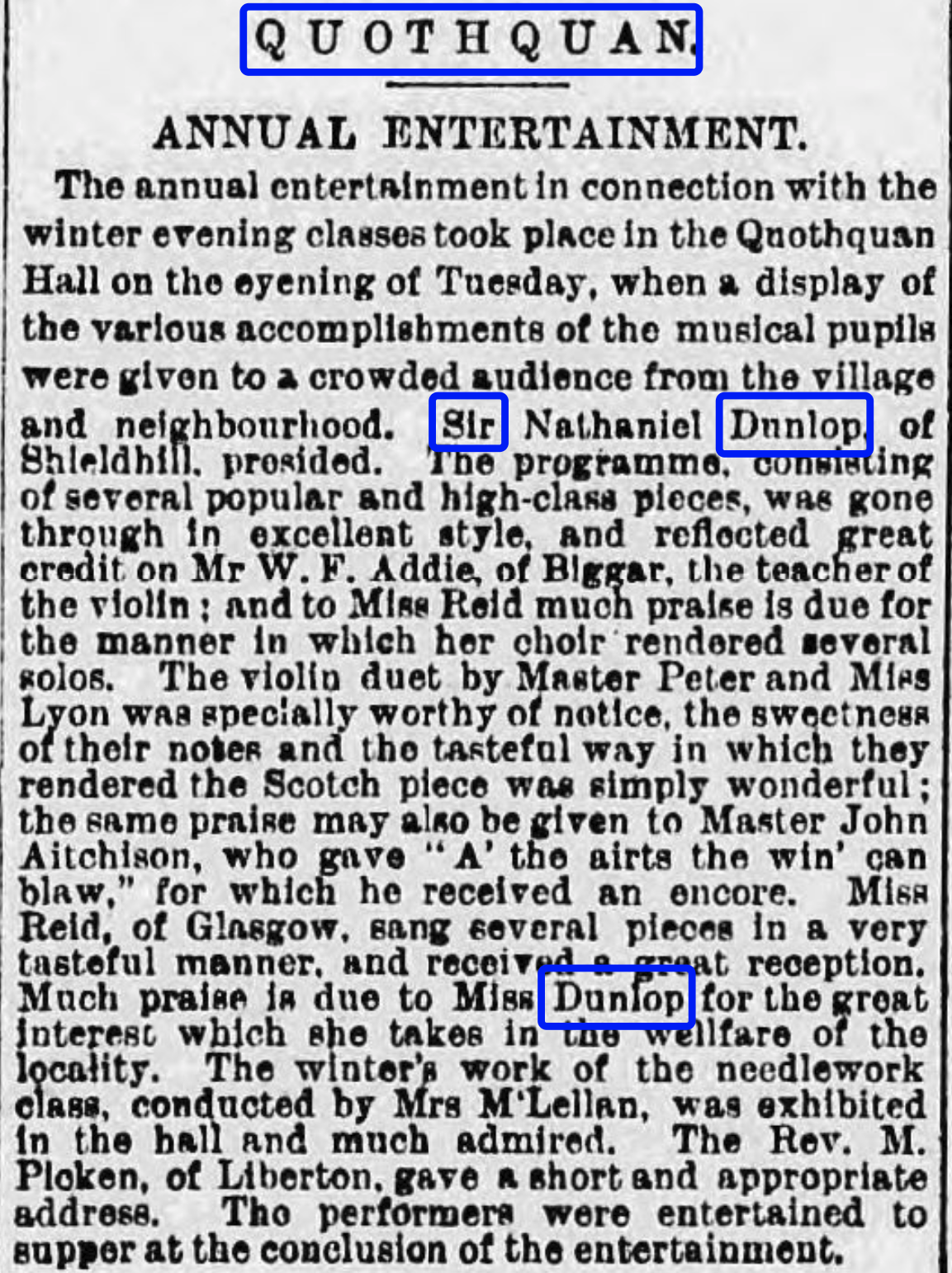
March 29, 1910
A crowded hall, three years after the birth
The report names Sir Nathaniel in the chair, W. F. Addie as violin teacher, Miss Reid as a singer and Mrs M’Lellan in connection with needlework. The activities outlasted the period of the pregnancy. They also depended on teachers, clergy, performers and families whose names survive alongside those of the owners.
Hamilton Advertiser, April 2, 1910, page 6 · Issue reference
How much influence did one household have?
Consider the July visit from a guest’s perspective as far as the report permits. The society assembled in Biggar. Ellen met the party, guided it to worship and hosted it at her family’s home. The minister led the service. The secretary reported on the society. Nathaniel arrived later. The distinction matters. The story preserves the authority of the landowner, the organizing work of his daughter, and the independent roles of the society and church.
The evidence supports a concentrated form of estate patronage. The Dunlops supplied premises, extended invitations and presided at public occasions. People who might work on the estate could also encounter the family as neighbours, pupils, worshippers and guests. The newspapers give us the hosts’ public reputation. They tell us little about how a young servant experienced those relationships in private.
There is no account here from Agnes describing pressure to attend, surveillance, punishment for staying away, control of courtship, or a demand for secrecy. No source cited here identifies Shieldhill as a cult. The records can support a precise question about social power: did access to housing, worship or assistance depend on maintaining the family’s favour? Tenancy terms, private correspondence, church minutes and testimony from residents would carry more weight on that point than newspaper praise.
Historic Environment Scotland, LB12995 · Hamilton Advertiser, July 21, 1906, page 5 · Issue reference · Hamilton Advertiser, March 17, 1906, page 6 · Issue reference
Nathaniel and Binnie, compared
Presence. Nathaniel has an on-site sighting in July 1906. His absence from the start of the festival is part of that evidence, too. Binnie’s relationship to the owner is documented in census and family records. His 1907 medical entry gives 16 Carlton Place, Glasgow. His former school’s register, published in 1905, gives Charteris House, Woodford Green, Essex. Neither address fixes his daily movements. No dated source presented here places the nephew at Shieldhill in the relevant autumn. No dated source places either man together with Agnes.
What the word “doctor” can mean. Binnie was a qualified medical practitioner before the pregnancy. Nathaniel received an honorary Doctor of Laws in April 1907. That distinction came after the estimated conception and before the birth. In June a newspaper used “Dr” for Nathaniel. If the family recollection specifically meant a practising physician, it points more naturally toward Binnie. If it preserved the title by which a man was known later, Nathaniel remains possible. Laurence’s daughter supplied a description, not either man’s name.
Age, standing and opportunity. In autumn 1906 Agnes was twenty, Binnie thirty-two and Nathaniel about seventy-six. Nathaniel was a shipping executive with an estate and a public role. His position helps explain why his movements appear in newspapers. It does not establish a relationship or payment. Binnie may have left fewer public traces. Counting articles about one man and comparing that total with silence about the other would exaggerate the difference.
Why Nathaniel leads. One man can be placed in the social setting itself, at a dated function in the relevant year. For the other, the chain stops at kinship, profession and addresses elsewhere. That is a defensible order for pursuing the two men. It gives no probability of paternity, and the identity of the father could lie outside the Dunlop family.
Dunlop household, 1861 · Dr James Dunlop’s obituary · 1905 college register · 1907 Medical Register · Glasgow newspapers, April 1907 · Naval & Military Record, June 6, 1907 · The London Gazette, July 26, 1907
Follow Agnes through the records
The neighbours. In 1901 Agnes lived with her uncle at Lime Tree Cottage. Mary Archibald, a sewing mistress, was recorded at Gean Tree Cottages. Mary’s brother Alexander, a domestic gardener, headed a household recorded at Shieldhill with his wife Annie and a servant. The census does not say which building the gardener occupied. Similar cottage names six years apart are a reason to track tenants. They do not establish that Mary and Agnes shared a household during the pregnancy.
The birth. Agnes gave birth at nine in the evening on June 14, 1907, at the Royal Maternity Hospital in Edinburgh. She registered Lawrence Brown on July 4. The father’s entry is blank. Autumn 1906 is an estimate from the birth date. A gestational age or an earlier clinical entry could shift that estimate. A summer festival and a winter concert sit on either side of the period that matters most.
Edinburgh. The electoral rolls list a Robert Douglas at 18 Lochrin Place around the time of the birth. In the 1911 census three-year-old Laurence was in the Douglas household at No. 16. Those are strong pieces of the child’s history. They leave the date of his move, the person who arranged his care, and the identity of his father unanswered. Likewise, Nathaniel’s reported appearances in Glasgow on June 21 and July 2, 1907 concern the registration period, months after the estimated conception.
The family account. Laurence’s daughter, Constance Anderson Douglas, told her son that her father’s father was a doctor at the estate and that a gardener took him in. Her recollection is preserved in her own right as family testimony. The identification of a gardener and two possible meanings of “doctor” makes her account investigable. It does not establish who took custody of the baby or who fathered him.
1901 Libberton census · Alexander’s census entry · Laurence’s civil birth entry · Lochrin Place electoral roll · 1911 Douglas household · Family testimony, maps and weather
What would change the finding?
A record from autumn 1906. The first target is a dated household diary, letter, guest book, estate account or local report placing either man and Agnes at the same address in approximately August–October. A long absence documented across that period would weaken that man’s case. A shared event would establish an opportunity to meet. A private letter acknowledging a child would carry much greater weight.
An address with a name attached. The 1905–06 and 1906–07 valuation rolls and any surviving rent book could identify the owner and tenant of Gean Cottage. A wage book or hiring agreement naming Agnes could identify her employer. The two records would answer different questions. Class registers or festival membership lists could settle whether she attended. Even proof of attendance would leave the identity of the father open.
Acknowledgment or support. A later correction to the birth entry, a sheriff-court aliment action for child support, or a parish relief application could name a man and state who supplied the information. A claim by the mother, an acknowledgment by a man and a court finding carry different evidential weight. Hospital registers and casebooks for June and July 1907 may reveal admission, discharge or a contact. Their usefulness does not depend on naming the father.
Family DNA. A match to relatives shared by uncle and nephew could support a Dunlop connection while leaving the individual unresolved. Documented descendants of different branches, multiple independent matches and the ability to account for other shared ancestors would matter. Until a record or a discriminating set of matches links an individual to this child, Laurence’s biological father remains unidentified.
Laurence’s civil birth entry · Chronological source register · University of Edinburgh archive catalogue, maternity registers LHB3/14 and casebooks LHB3/16
The wider chronology
- 1830Nathaniel’s birth year, consistent with his stated age of 31 in the 1861 household
- 1885Agnes McGarth Brown born, December 18
- 1891Agnes, five, a few doors from the Archibalds in the Quothquan row
- 1901Alexander’s household recorded at Shieldhill, Mary at Gean Tree and Agnes at Lime Tree
- 1902New Year dance in the mansion for servants and villagers, "with their usual generosity"
- 1903Nathaniel and Ellen build Shieldhill Hall
- April 1, 1903Interviewed in Glasgow and photographed as head of the Allan Line
- May 1906Water supply for the houses at Quothquan "belonging to him"
- July 11, 1906Girls' Friendly Society festival at Shieldhill; Mr Dunlop welcomes them
- Autumn 1906Agnes becomes pregnant (counted back from the birth)
- November 1906Scottish Field features Shieldhill
- Winter 1906–07Classes in the hall; concert with the laird in the chair
- April 23, 1907Nathaniel made an honorary Doctor of Laws: "Dr. Nathaniel Dunlop"
- June 14, 1907Lawrence Brown born at the Royal Maternity Hospital, Edinburgh
- June 28, 1907Nathaniel named a knight
- June 29, 1907Speaks at the opening of the Carnwath golf course
- July 4, 1907Agnes registers her son in Edinburgh, giving her home as Gean Cottage, Shieldhill
- April 1909Publishes “Unemployment: its cause and cure” in Blackwood’s Magazine
- May 20, 1909Writes to John Rankin from Shieldhill
- 1911Laurence, three, with the Douglases at 16 Lochrin Place; Agnes a nurse about a mile away
- 1914His marble bust by Sir George Frampton shown at the Royal Academy
- 1919Nathaniel dies. His testament was recorded in 1920.
- November 17, 1919His death reported in the Chicago Daily Tribune: “survived by one daughter”